D-Day:
The Normandy Landings of 6 June 1944
Discover the story of D-Day, from months of secret planning and deception to the airborne landings, five invasion beaches and the beginning of the campaign to liberate Western Europe.
The day that opened the road to liberation
On 6 June 1944, Allied forces launched the Normandy landings, an immense military operation that became one of the defining events of the Second World War.
D-Day formed the opening stage of Operation Overlord, the Allied campaign to establish a foothold in occupied France. Thousands of sailors, soldiers and airmen from many nations took part in an operation of extraordinary scale and complexity.
This D-Day timeline explores the planning, deception, airborne operations, landings and legacy of 6 June 1944, as well as the Battle of Normandy that followed.
D-Day Timeline: Planning Operation Overlord
The invasion of Normandy was the result of months of military planning, logistics, intelligence and deception.
Planning the Return to Europe
By 1943, Allied leaders were preparing for a major cross-Channel invasion that would establish a new front in Western Europe.
The plan eventually became known as Operation Overlord, with Normandy selected as the invasion area.
Southern England Becomes a Staging Ground
In the months before D-Day, large parts of southern England were transformed by the concentration of troops, vehicles, aircraft, ships and supplies.
Training intensified as forces prepared for a type of amphibious operation on a scale never previously attempted.
Deception and Secrecy
The Allies knew that complete secrecy was impossible, so deception became central to the operation.
False military formations, misleading radio traffic and other measures were used to encourage German commanders to believe that the main invasion might fall elsewhere, particularly around the Pas-de-Calais.
Weather Delays the Invasion
D-Day was initially planned for 5 June 1944, but poor weather made conditions too dangerous.
A brief improvement in the forecast offered a narrow opportunity, and the decision was taken to proceed on 6 June.
The success of D-Day depended not on one force or one nation, but on an enormous combined effort by troops, sailors, aircrew, engineers, intelligence teams and countless others.
The D-Day Landings Begin
Before dawn, Allied airborne forces were already moving into Normandy as the invasion fleet approached the coast.
Airborne Forces Land Behind Enemy Lines
In the early hours of 6 June, thousands of British, American and Canadian airborne troops crossed into Normandy by parachute and glider.
Their objectives included securing bridges, disrupting German communications and preventing reinforcements from reaching the invasion beaches.
The Naval and Air Bombardment
As daylight approached, Allied naval vessels and aircraft attacked German coastal positions in preparation for the landings.
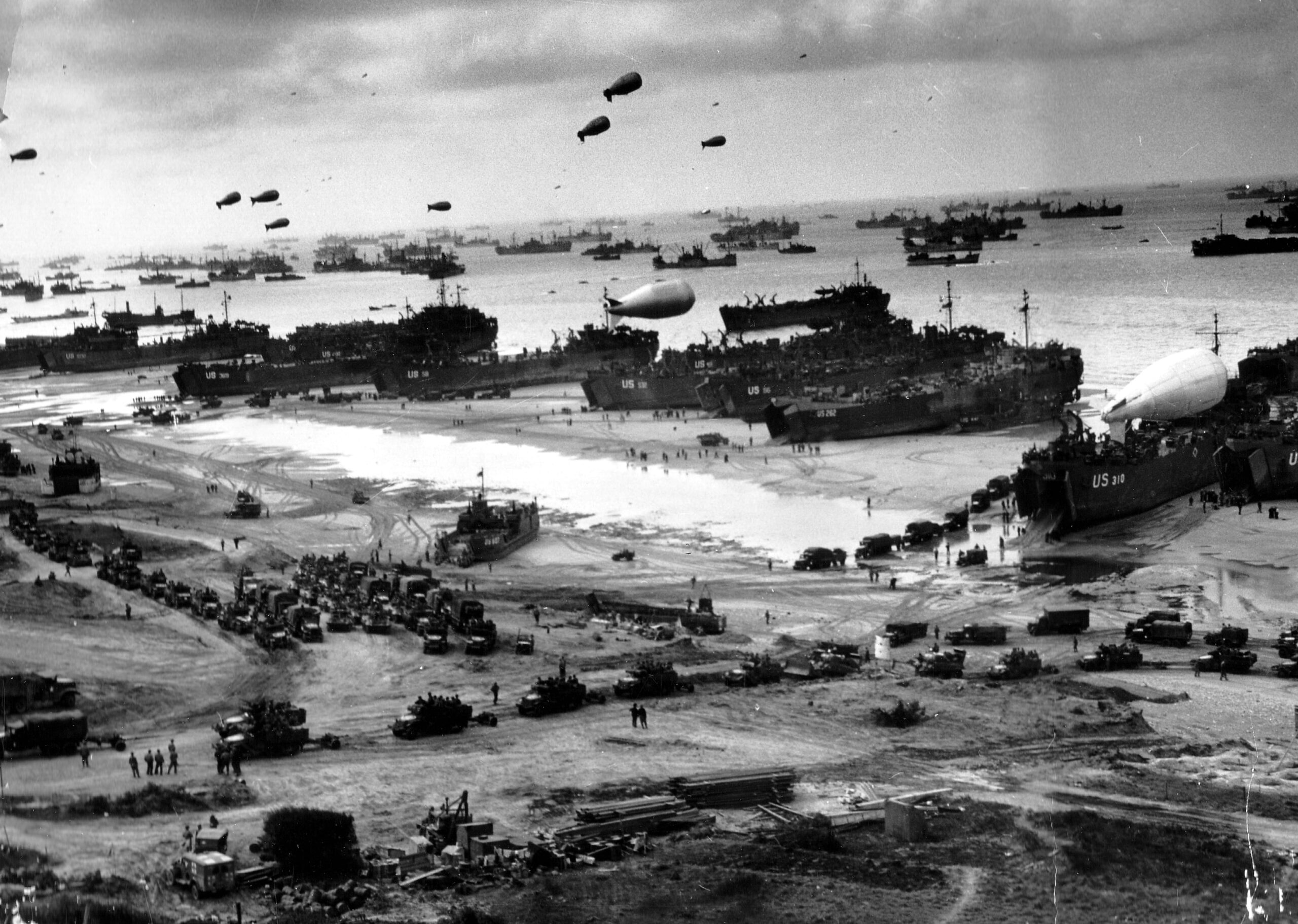
Offshore, an enormous invasion fleet carried troops, vehicles, landing craft and supplies towards Normandy.
Troops Come Ashore
More than 130,000 ground troops landed across a stretch of coastline approximately 50 miles long.
The five main landing beaches were codenamed Utah, Omaha, Gold, Juno and Sword.
A Foothold in Normandy
By the end of 6 June, Allied forces had established positions along the Normandy coast.
Not every objective had been achieved and resistance had been severe in several areas, but the Allies had successfully created the foothold needed to continue the campaign.
The Five D-Day Landing Beaches
Each beach presented different terrain, defences and tactical challenges.
Utah
The westernmost landing area, assaulted primarily by American forces.
Omaha
The scene of particularly severe fighting and heavy Allied casualties.
Gold
One of the principal British landing beaches on the Normandy coast.
Juno
The principal Canadian landing area, supported by Allied naval and air power.
Sword
The easternmost of the five main landing beaches, assaulted largely by British forces.
An Operation Without Precedent
Approximately 24,000 airborne troops landed by parachute and glider in the opening hours.
More than 130,000 troops came ashore on the Normandy beaches on D-Day.
Utah, Omaha, Gold, Juno and Sword formed the principal landing areas.
The Battle of Normandy
D-Day was not the end of the campaign. It was the beginning.
Building the Allied Bridgehead
After the initial landings, Allied forces worked to link the beachheads, bring in reinforcements and expand their positions inland.
Ports, roads and towns became vital objectives as more troops and supplies crossed the Channel.
Fighting Through Normandy
The countryside of Normandy created difficult conditions for the advancing Allied armies.
Fighting through villages, towns, fields and dense hedgerows proved costly and far slower than many planners had hoped.
The Campaign Breaks Open
By August, Allied forces were breaking out of Normandy and German forces were being pushed eastwards.
The success of the Normandy campaign opened the road towards the liberation of Paris and the wider advance across Western Europe.
Why D-Day Is Still Remembered
D-Day is remembered not only for its military scale, but for the people who took part in it.
Soldiers landing from crowded craft, paratroopers descending in darkness, sailors guiding vessels through dangerous waters, aircrew supporting the invasion and thousands of others working behind the front all formed part of the operation.
Allied casualties on 6 June alone numbered around 10,000, and the fighting in Normandy continued for many weeks afterwards.
Today, memorials, cemeteries, museums and annual commemorations preserve the stories of those who served and those who never returned.
The 80th Anniversary of D-Day Collection
Commemorative coins can provide a tangible connection to important moments in military history. Kensington Mint's 80th Anniversary of D-Day Collection marks the events and legacy of 6 June 1944.
Find Out About the CoinCourage, Sacrifice and Remembrance
D-Day was the product of extraordinary planning,
international cooperation and human courage.
The landings of 6 June 1944 did not end the war,
but they established the foothold from which Allied
forces could begin the liberation of Western Europe.
More than eight decades later, the story of D-Day
continues to be remembered through the veterans who
survived it, the lives of those who did not return,
and the generations who continue to preserve their memory.